Imagine your favorite ice cream shop. They don't just have vanilla, chocolate, and strawberry. Oh no, they have hundreds of flavors, all blended together in tiny, subtle variations. That’s kind of like what we're talking about when we discuss a continuous random variable. It’s a fancy way of saying that a measurement can take on any value within a range, not just specific, separate steps.
Think about the exact weight of a perfectly ripe banana. It’s not going to be exactly 100 grams or 101 grams. It could be 100.345 grams, or 100.345678 grams, or any number in between. The possibilities are endless, like counting grains of sand on a beach. Each grain is slightly different, and you can always find a grain in between any two you pick.
Now, how do we talk about the likelihood of getting a banana of a certain weight? This is where the Probability Density Function, or PDF, waltzes in. Think of it as a recipe for probabilities. It tells us how "dense" or likely the chances are for certain values within that endless range.
A PDF isn't going to give you a single number like "the probability of a banana weighing exactly 100 grams is 5%." That's because with an infinite number of possibilities, the chance of hitting one exact point is, well, practically zero. It's like trying to land on a single, specific atom in a whole city.
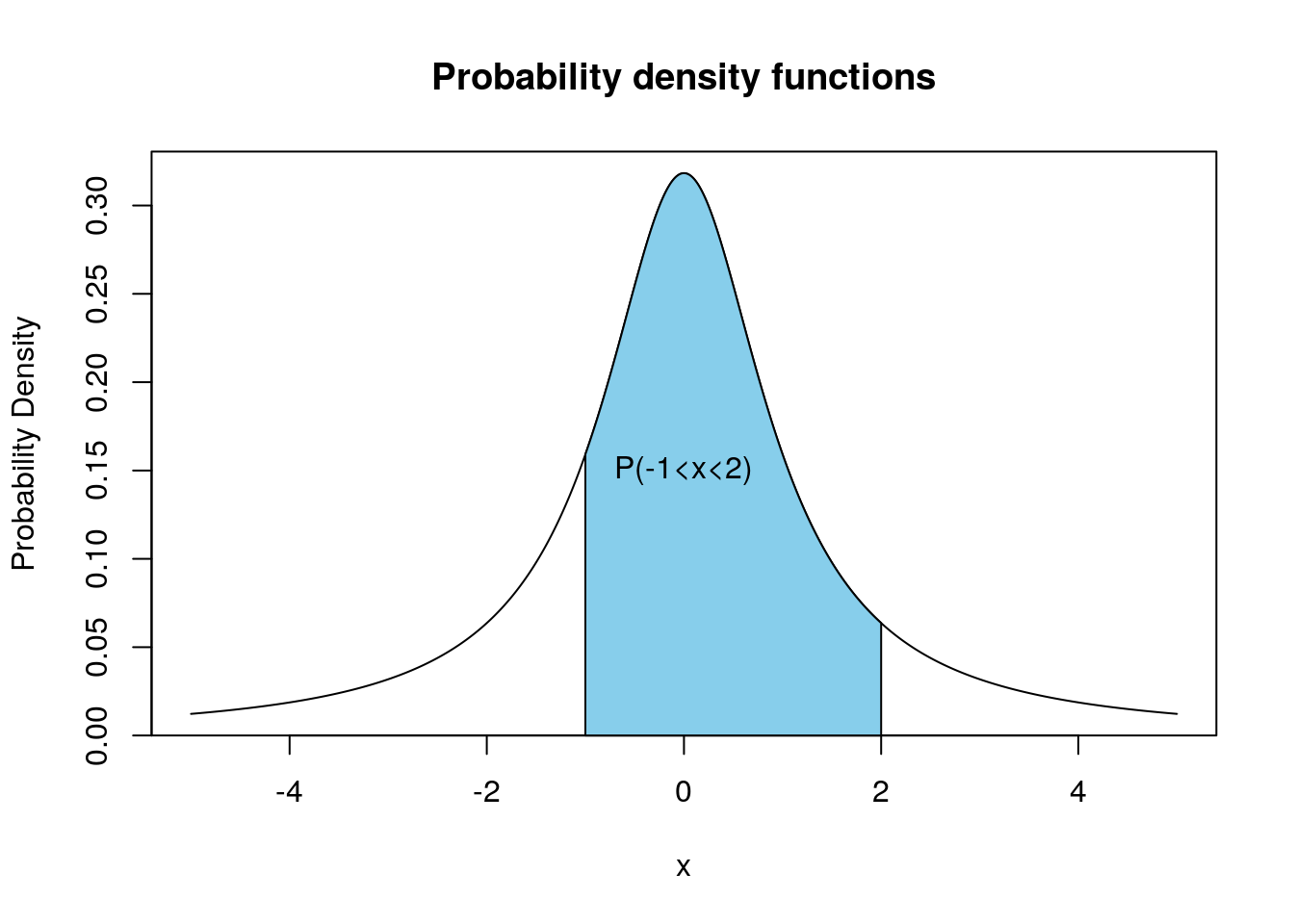
Instead, the PDF helps us talk about ranges. We can ask, "What's the probability that our banana weighs between 100 and 105 grams?" The PDF gives us the tools to figure this out. It's like asking, "How much of the sand on the beach falls within this specific bucket?"
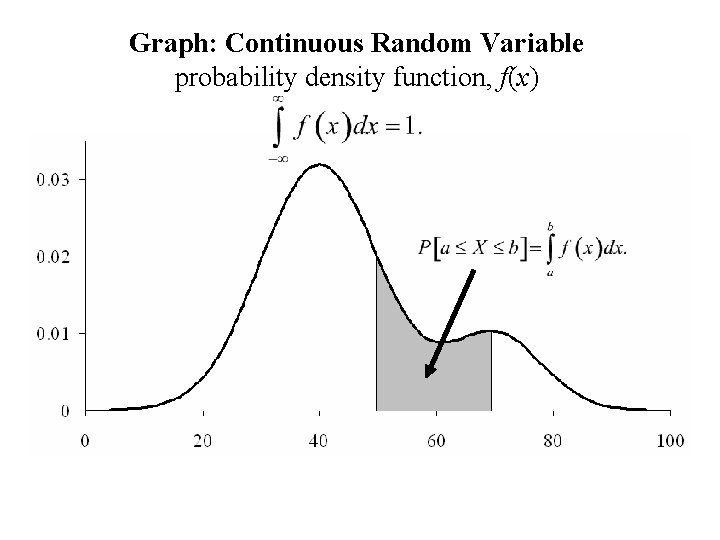
The graph of a PDF often looks like a gentle hill or a series of hills. The taller the hill at a certain point, the more likely that value is to occur. A flat part of the graph means all values in that section are equally likely.
One of the most heartwarming examples of a PDF in action is in predicting the height of people. We know that most people aren't super short or super tall. The PDF for human height looks like a bell curve – a beautiful, symmetrical hill. The peak of the bell represents the average height, and the sides taper off, showing that very short and very tall people are less common.
This bell curve, often called the normal distribution, is everywhere! It’s not just about heights. It’s about the lifespan of a lightbulb, the scores on a standardized test, even the amount of time it takes for your favorite pizza to arrive.
Sometimes, PDFs can be a bit lopsided, like a hill tilted to one side. This means some outcomes are more likely than others. Imagine the time you spend waiting for a bus. Sometimes it's quick, sometimes it takes ages. The PDF might show a peak for shorter waiting times, but still have a long, tapering tail for those unusually long waits.
What’s truly fun is when we realize how these PDFs help us understand the world. They’re like a secret language that scientists and statisticians use to describe all sorts of unpredictable, yet fundamentally understandable, phenomena. It’s not about predicting the exact outcome, but about understanding the tendency or the average behavior.
Think about the number of freckles on your nose. Each person is different, and the exact number of freckles is a continuous random variable. While you might not have exactly 50 freckles, or 50.2 freckles, the PDF can tell us the likelihood of having, say, between 40 and 60 freckles. It's a way to appreciate the unique variations that make each of us special.

One of the surprising things about PDFs is that the total area under the entire curve is always equal to 1. Why 1? Because the total probability of all possible outcomes happening has to be 100%, or 1 in math terms. It’s a fundamental rule that keeps everything in balance.
It’s like a pie chart for probabilities. Even though the "slices" can be infinitely thin and touch each other, their total area represents the whole pie, which is 100% certainty.
Sometimes, you might encounter a PDF that looks a bit like a staircase. This happens when we're dealing with something that looks continuous but is actually made up of tiny, discrete steps. Think about the price of gas. It doesn't change every single second, but it changes in small increments, like pennies. The PDF for gas prices might have a stair-step pattern, reflecting these tiny jumps.
The beauty of the PDF is its ability to capture this vastness. It’s not about fixing on a single point, but about embracing the spectrum. It’s the quiet hum of the universe, the gentle ebb and flow of everyday life, all laid out in a landscape of probabilities.

So, the next time you’re enjoying that perfectly brewed cup of coffee, or marveling at the changing colors of the sunset, remember the continuous random variables and their trusty companions, the Probability Density Functions. They’re silently at work, helping us make sense of the beautiful, messy, and wonderfully unpredictable world around us.
It’s the gentle curve of a smile, the subtle variation in a loved one’s voice, the perfect temperature of a summer breeze. These aren't single, fixed points. They are ranges, nuances, and the PDF is our guide to understanding the likelihood of experiencing them.
This idea might seem a little abstract, but it’s deeply ingrained in how we experience joy, anticipation, and even a little bit of surprise. The PDF is like the underlying rhythm to the music of our lives, a constant, gentle beat that shapes our expectations and our experiences.
Don't let the fancy name scare you. A PDF is simply a tool for understanding how likely different outcomes are when things can vary smoothly. It’s like knowing that sunshine is more likely in the summer than in the winter, but you can’t predict the exact temperature of tomorrow.
Think of the weight of a cloud. It's not a solid object with a single fixed weight. It’s a vast, swirling mass, and its weight can vary continuously. The PDF helps us understand the likelihood of a cloud having a certain amount of water in it, which in turn affects whether it will rain.
It’s the subtle differences that make life interesting. A PDF embraces these differences. It’s the reason why no two snowflakes are exactly alike, and why every journey, even to the same destination, can feel unique. The PDF is there, a quiet observer, mapping out the possibilities.
So, let’s raise a glass – or perhaps a perfectly blended smoothie – to the continuous random variable and its faithful Probability Density Function. They’re the unsung heroes that help us appreciate the glorious, never-ending spectrum of what life has to offer.