Imagine you're at the world's biggest library, a place so vast it makes the pyramids look like Lego bricks. You've got a super important mission: find that one specific book, the one with the sparkly cover that contains the recipe for the universe's best chocolate chip cookies. Now, if you started from the very first shelf and read every single title, well, you'd probably be a grandparent by the time you found it. That's where our hero, the Binary Search Algorithm, swoops in to save the day!
Think of it like this: instead of blindly rummaging, Binary Search is like having a magical, super-powered librarian who knows exactly how to narrow things down. This librarian doesn't waste time. They're all about efficiency, about getting you to that cookie recipe faster than a toddler spotting a dropped cookie.
So, how does this magical librarian work their charm? First off, they have a crucial rule: the books in our colossal library must be perfectly, impeccably ordered. Imagine them stacked alphabetically by author, or by publication date, or even by how many times they've been checked out (though that might get messy!). The key is that there's a clear sequence, a predictable flow.
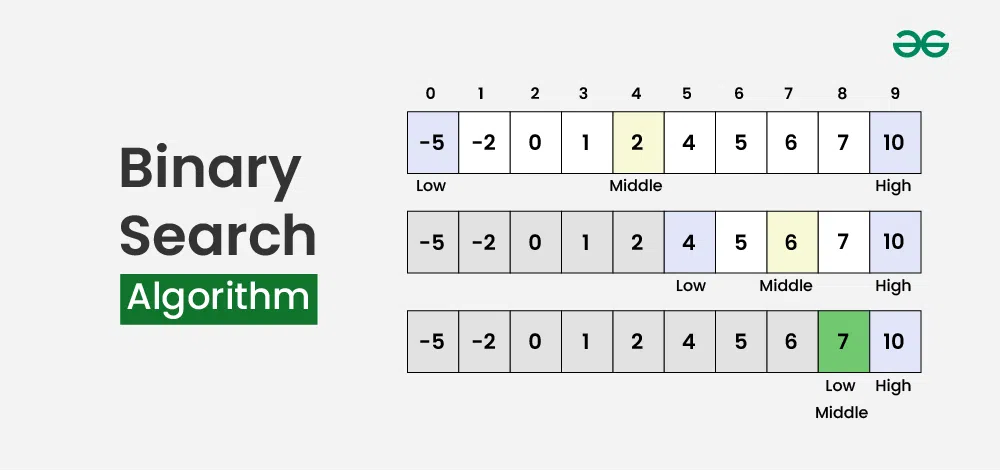
Our Binary Search librarian begins by taking a giant leap right to the middle of the entire library. Not the beginning, not the end, but smack-dab in the center! They pull out that book and give it a quick glance. Is this our cookie recipe book?
Let's say it's not. But here's the genius part! Because everything is ordered, the librarian instantly knows if their book is before or after the one they just checked. If the book in the middle has a title that comes before "Universe's Best Chocolate Chip Cookies" alphabetically, then our librarian knows, with absolute certainty, that the cookie book cannot possibly be in the first half of the library! Poof! Half the library is instantly eliminated.
Alternatively, if the middle book's title comes after "Universe's Best Chocolate Chip Cookies," then our librarian knows the cookie book can't be in the second half. Shazam! The other half is gone. See how quickly we're making progress? No more slogging through aisles of dusty encyclopedias about the mating habits of obscure beetles.
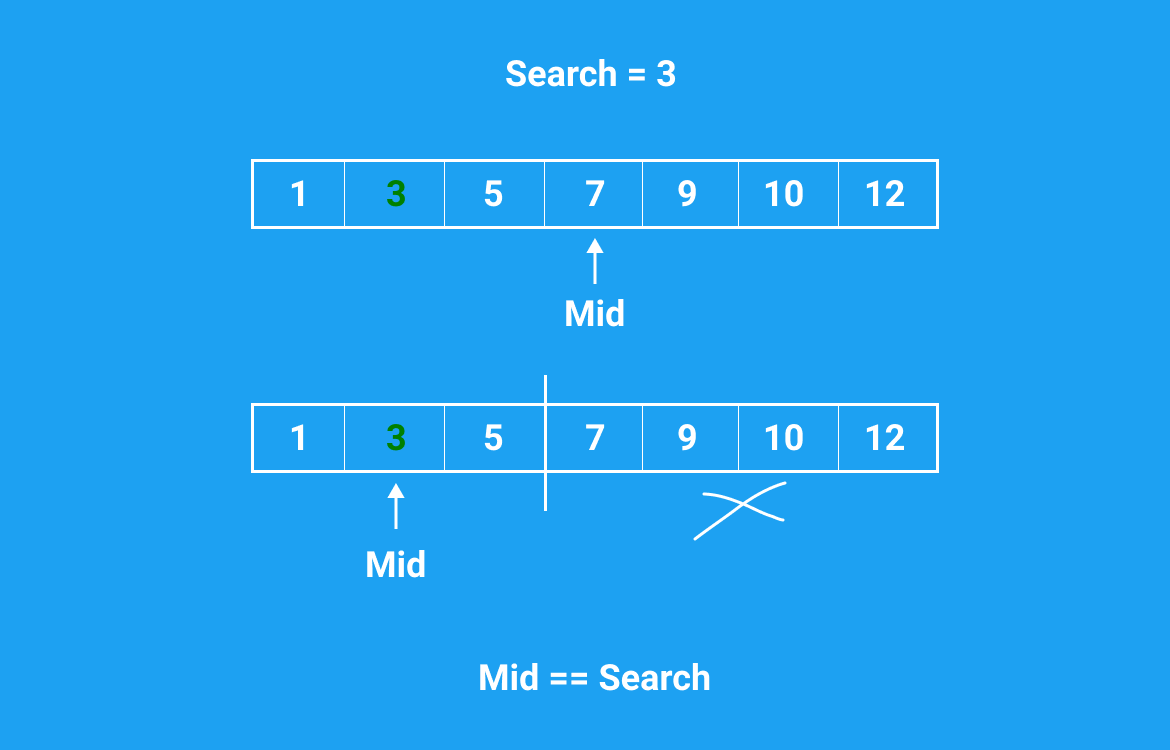
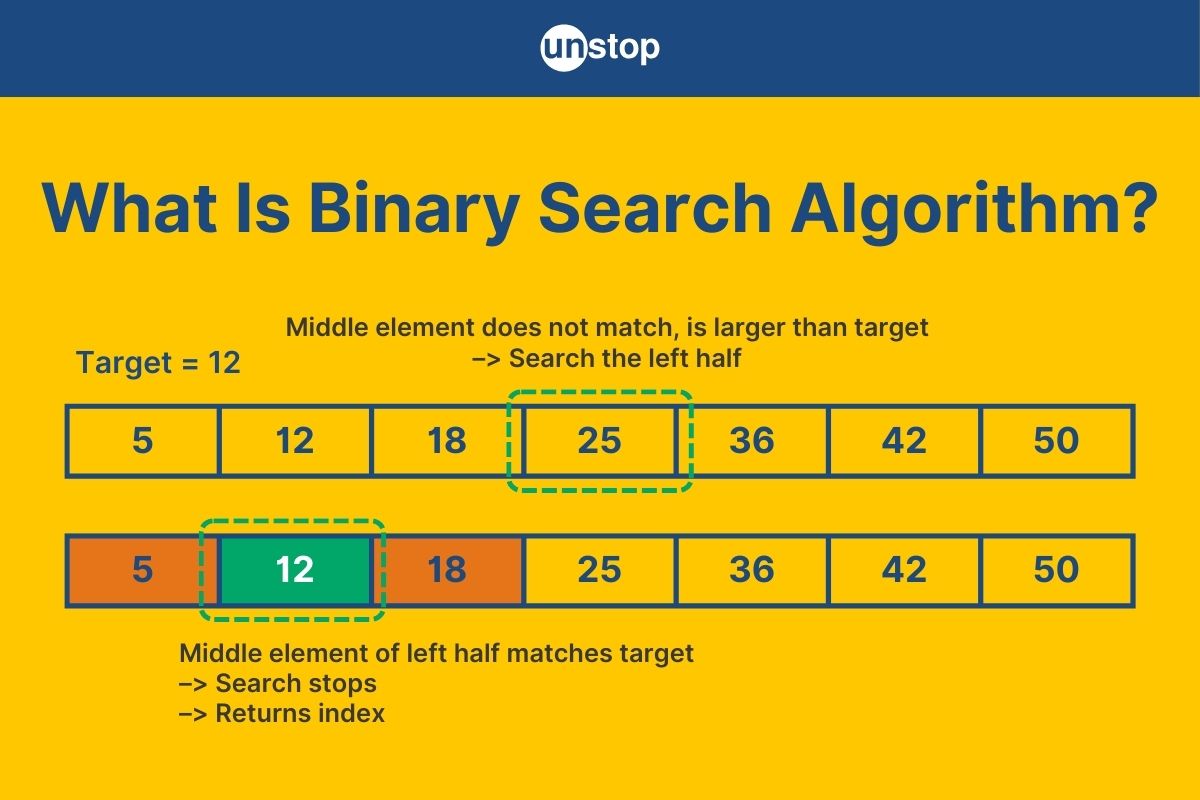
So, the librarian has now effectively cut the search area in half. They are left with a still massive, but significantly smaller, section of the library. What do they do next? You guessed it! They repeat the exact same process.
They go to the middle of this new, smaller section. They pull out that book and compare it to our precious cookie recipe. Again, they decide if the cookie book is before or after this new middle book. And again, with a flick of their wrist, they eliminate another half of the remaining possibilities.
This is where the real magic happens. With each step, the search space shrinks dramatically. It's like playing a game of "hot or cold" but with an infinite number of players and an infallible sense of direction. Each comparison is a powerful decision, slicing through the uncertainty like a laser beam.
Let's consider another fun example. Imagine you're trying to guess a number between 1 and 100. If you just guess randomly, you might be there all day! But if you use Binary Search, you'd first guess 50. If someone says "higher," you know the number is between 51 and 100.
Your next guess? The middle of that range: 75. If they say "lower," you've just eliminated another huge chunk. The number is now between 51 and 74. You'd then guess the middle of that range, and so on. You'd find the number in just a handful of guesses, not a lifetime.
This process continues, halving the search area at each step, until finally, our librarian plucks the exact book you're looking for from the shelf! Or, if by some cosmic joke the cookie recipe book doesn't exist in this library (perish the thought!), the algorithm would eventually realize there's nothing left to search. It's incredibly efficient.

The beauty of Binary Search is its incredible speed. For a list of, say, 1000 items, it would take at most about 10 guesses to find what you're looking for. If you had a million items? Still only about 20 guesses! It's mind-bogglingly fast. It scales beautifully, meaning it handles enormous amounts of data without breaking a sweat.
Think about how this applies to the digital world. When you search for something on the internet, or when your computer finds a file, often a form of Binary Search (or something very similar) is working behind the scenes. It’s the silent guardian, the watchful protector of your search queries, making sure you get your results lightning-fast. Without it, your online experience would be like trying to find a needle in a haystack... blindfolded... during an earthquake.
So, the next time you're amazed at how quickly you find information, remember our trusty Binary Search Algorithm. It's the clever, organized, and incredibly speedy way to find exactly what you're looking for, by consistently dividing and conquering. It’s a testament to how simple, clever rules can lead to magnificent results, making our digital lives so much easier and, dare we say, tastier, with the promise of those perfect chocolate chip cookies.
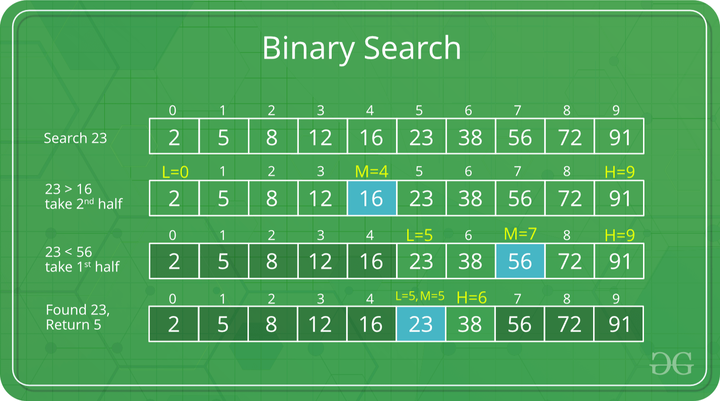
It’s all about that divide and conquer strategy. Start in the middle, decide which half to keep, and do it all over again. Simple, elegant, and incredibly effective. It’s the superhero of searching, always ready to swoop in and find your target in record time, leaving no stone (or book, or number) unturned, or rather, perfectly accounted for!
The key takeaway is this: Binary Search demands order. If your items are all jumbled up like a toddler's playroom after a sugar rush, it can't do its magic. But if everything is neatly lined up, it's your ultimate shortcut. It turns a daunting task into a quick win, a frustrating quest into a triumphant discovery.
So, there you have it! The wonderful world of Binary Search. It’s the silent, efficient engine that powers so much of our digital lives, all by cleverly halving the problem with every single step. Pretty cool, right? Now, about those cookies...