
Ever found yourself staring at a folder, your mind a whirlwind of questions? "Is this thing truly empty?" you ponder, a digital detective on a mission for the void. Well, fear not, fellow digital adventurers, because Python has your back! We're about to unleash a secret weapon in your quest to conquer the empty directory!
Imagine this: you've just downloaded a whole bunch of files, and you're sure you've moved them somewhere. But where? And did that folder you thought you emptied actually get the memo? It’s like playing hide-and-seek with your own data, and sometimes, the directory wins.
This is where our trusty friend, Python, swoops in like a superhero in a cape made of pure code! It can peek inside that folder and tell you, with absolute certainty, if it's as barren as a desert island with no Wi-Fi. No more second-guessing, no more endless scrolling through files you might have. Just clear, concise answers!
The Grand Investigation: Is It Empty or Not?
Our mission, should we choose to accept it, is to determine the emptiness status of a directory. Think of it like checking if your cookie jar is truly empty after a late-night craving, or if your sock drawer has any matching pairs left (a truly rare phenomenon for some!). Python makes this an absolute breeze.
The magic happens with a special tool called the `os module. This is like Python's toolbox, filled with all sorts of handy gadgets for interacting with your computer's file system. It’s where all the cool stuff for managing files and folders lives!
Unearthing the Secrets: `os.listdir()`
One of the most fundamental tools in this toolbox is the `os.listdir() function. Now, this function is like a diligent secretary who meticulously lists everything inside a given directory. Every file, every subfolder, every stray digital dust bunny – it’s all there in a neat little list.
When you use os.listdir(), you give it the path to the folder you want to inspect. It then returns a list of all the items within that folder. If the folder is truly empty, you know what that list will look like, right? It'll be… empty! Just like your wallet after a trip to the candy store.
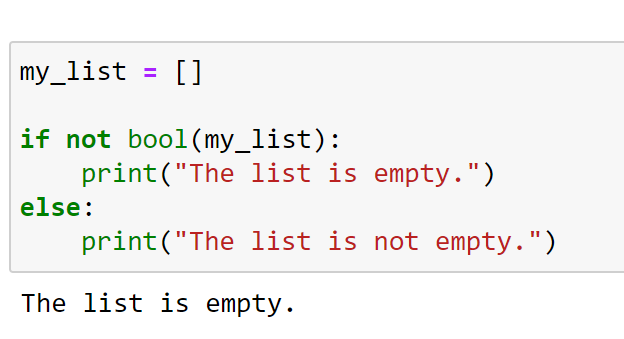
So, if os.listdir('/path/to/your/mysterious/folder') returns an empty list, congratulations! You’ve found a truly vacant space in your digital universe. It's a moment of triumph, a silent cheer for a job well done.
The Ultimate Test: The Length of the List
Now, how do we programmatically tell if that list returned by os.listdir() is empty? This is where a little bit of Python wizardry comes in. We can simply check the length of the list!
Every list in Python has a length, which is simply the number of items it contains. If a list is empty, its length is 0. It’s like counting your fingers – if you have no fingers, the count is zero. Simple, elegant, and incredibly effective!
So, the grand plan is:
- Use
os.listdir()to get a list of items in the directory. - Check the length of that list.
- If the length is 0, the directory is empty! Hooray for us!
Putting It All Together: The Code That Sings!
Let's see this beautiful dance of code in action. Imagine we have a folder named 'my_downloads' that we suspect might be a black hole for forgotten files. Here’s how we’d put Python to work:

import os

directory_to_check = 'my_downloads'

# Get the list of items in the directory
items_in_directory = os.listdir(directory_to_check)

# Check if the list is empty
if len(items_in_directory) == 0:
    print(f"The directory '{directory_to_check}' is as empty as a politician's promise on election day!")
else:
    print(f"Whoa there! The directory '{directory_to_check}' is NOT empty. It contains: {items_in_directory}")
Isn't that just delightful? The code itself tells a story. We import our trusty os module, define the directory we're curious about, and then, with a flourish, we get the list of its contents. The crucial part is that simple if len(items_in_directory) == 0:. If the length is indeed zero, we get a congratulatory message. If not, well, we get a little heads-up about what’s lurking within.
This is the beauty of Python – it makes complex tasks feel… well, not so complex! It’s like having a tiny, super-smart assistant living inside your computer, ready to perform these digital investigations at your command.
Beyond the Basics: A Little Extra Shine
While checking the length of the list from os.listdir() is the most straightforward and common way, Python offers other fascinating avenues. It’s like discovering there are more ways to make toast than just toasting it!
One such alternative involves using `os.scandir(). This function is a bit more advanced, but it’s incredibly efficient, especially for very large directories. Instead of just giving you a list of names, it provides directory entries, which contain more information about each item.
If you were to use os.scandir(), you would get an iterator. An iterator is like a conveyor belt of information. You can then check if this conveyor belt has any items on it. If it’s empty, guess what? The directory is empty!
The Power of `os.scandir()`: A Sneak Peek
Here’s a little glimpse into the world of os.scandir() for checking emptiness:
import os

directory_to_check = 'another_empty_candidate'

with os.scandir(directory_to_check) as entries:
    if not any(entries):
        print(f"Behold! '{directory_to_check}' is a true paragon of emptiness.")
    else:
        print(f"Alas, '{directory_to_check}' has contents. The void is not complete here.")
Notice the elegant use of if not any(entries):. This is like asking the conveyor belt, "Are there any items on you?" If the answer is no, then our directory is declared gloriously empty. It’s a subtle but powerful way to achieve the same goal.
The with statement here is also neat. It ensures that everything related to the `os.scandir()` operation is cleaned up properly, even if something unexpected happens. It’s like having a diligent butler who tidies up after the party.
Why Does This Even Matter? The Real-World Fun!
You might be thinking, "Okay, this is cool, but why would I need to know if a directory is empty?" Oh, the possibilities are as vast as the internet itself!

Imagine you have a script that automatically downloads reports. You want to make sure you don't process an empty directory, which could lead to errors or confusing messages. Knowing if it’s empty beforehand saves you from a potential digital headache. It’s like checking if you have ingredients before starting to bake a cake – much less messy!
Or perhaps you’re cleaning up old, unused folders. You might want to delete empty folders to keep your file system tidy. Python can help you identify these pristine, forgotten corners of your storage, ready to be wiped clean.
It’s also fantastic for automated tasks. If a process is supposed to produce files in a certain directory, you can use Python to quickly verify that it did its job. If the directory is still empty, something went wrong, and you can be alerted immediately. No more wondering if your automated assistant is slacking off!
Embrace the Pythonic Power!
So there you have it! The simple, elegant, and incredibly useful art of checking if a directory is empty using Python. With the power of the `os module and a little understanding of lists or iterators, you can become a master of directory emptiness detection.
Don’t let those mysterious, potentially empty folders keep you up at night. Harness the brilliance of Python, and you’ll be able to distinguish a truly vacant digital space from one that’s just playing shy. Go forth and check those directories with confidence and a smile!