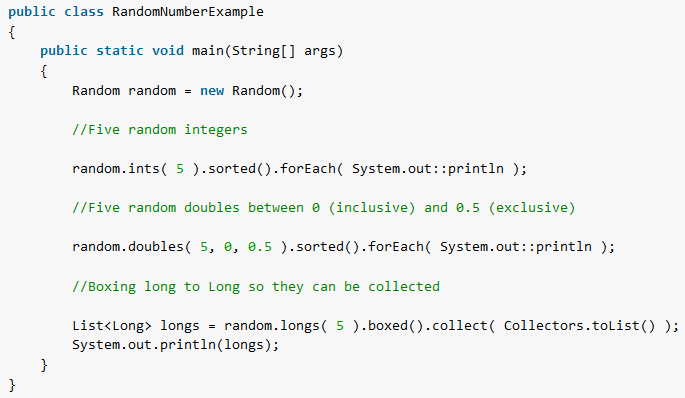
Ever feel like life is just a little too predictable? Like you know exactly what's going to happen next? Well, what if I told you there's a secret sauce in the world of computer programming that injects a delightful dose of surprise, a sprinkle of serendipity, and a whole lot of FUN into your code? We're talking about random numbers, my friends! And not just any random numbers, oh no. We're diving headfirst into the wonderfully wild world of random numbers within a specific range in Java.
Imagine you're playing a board game. You wouldn't want to know that you're always going to roll a 6, would you? That would get boring faster than a lukewarm cup of tea. The magic happens when you roll a die and could get anything from a 1 to a 6. That's the thrill! And that's exactly what we're bringing to our Java programs.
Think of Java as your personal playground for creating digital adventures. And sometimes, you need a little bit of unpredictability to make those adventures truly exciting. This is where our trusty random number generators come into play, ready to dish out a surprise whenever you need it.
So, what does it mean to have a "range"? It's like setting the boundaries for your surprise. Instead of just getting any old random number that the computer dreams up, we tell it, "Hey, Computer Buddy, I want a number between THIS and THAT." Super simple, right? It’s like telling a chef, "Give me a dessert, but please, no anchovies." You're setting the delicious parameters!
In Java, the star of our random number show is often the Random class. This little gem is like a magical hat from which we can pull out numbers. And the best part? It's surprisingly easy to use. You don't need to be a wizard or a mad scientist to wield its power.
Let's say you're building a simple guessing game. You want the computer to pick a secret number, and you want it to be, let’s say, between 1 and 100. You wouldn't want it picking a number so high it’s practically in another galaxy, nor one so low it’s practically underground! A nice, manageable range is what we're after.

This is where our Random class shines. You create an instance of it, like opening up your magic hat. Then, you use its methods, like reaching into the hat to pull out a number. One of the most useful methods is nextInt(int bound). This is your go-to for getting an integer.
Now, here's a tiny, almost imperceptible quirk to remember: nextInt(int bound) gives you a number from 0 (inclusive) up to, but not including, the bound you provide. So, if you want numbers up to 100, you'd use nextInt(101). It's like saying, "Give me everything up to the 101st step, but stop right before you get there!" A little dance of numbers, if you will.
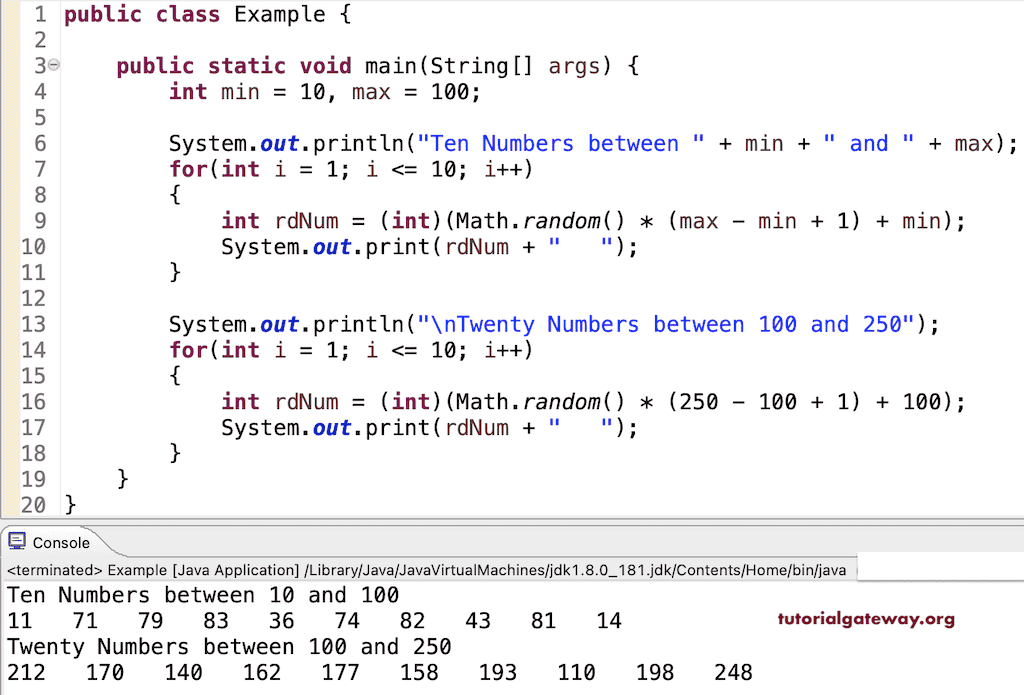
But wait, you want a range that doesn't start at zero, right? Maybe you want numbers between 10 and 20. No problem! We can totally do that. It just takes a smidge more mathematical finesse, like adding a secret ingredient to your recipe.
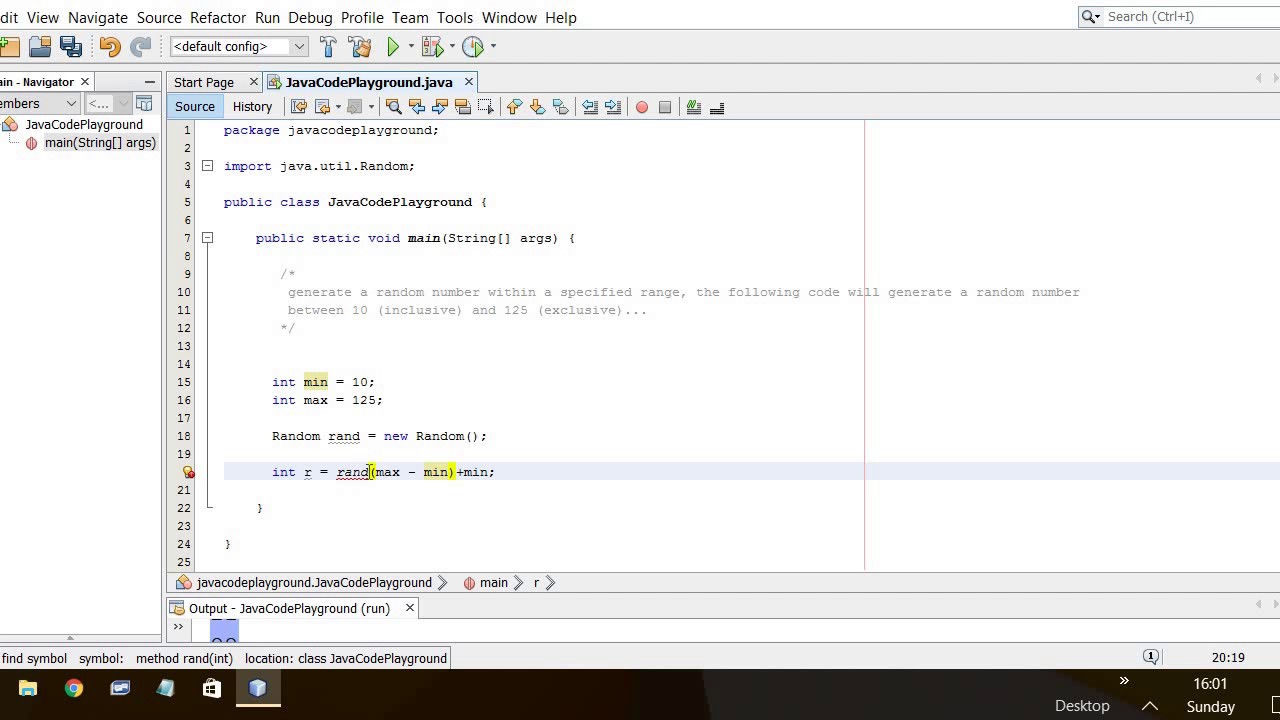
Here's the playful secret: we generate a random number within a smaller, easier range (like from 0 up to the size of our desired range), and then we simply shift it by adding our starting point. It's like picking a card from a shuffled deck and then saying, "Okay, now consider this card to be worth 10 points more." Sneaky and effective!
So, for a range of 10 to 20 (inclusive), our desired range size is 11 numbers (20 - 10 + 1). We would generate a random number between 0 and 10 using nextInt(11). Then, we'd add our starting number, 10, to the result. Voila! A random number between 10 and 20 appears as if by magic.
Think about it like this: you want to pick a lucky number from a jar that has tickets labeled 10, 11, 12, all the way up to 20. You don't have a jar like that directly. But you do have a jar with tickets labeled 0, 1, 2, up to 10. So, you pull a number from the second jar, and then you mentally add 10 to whatever you picked. If you pulled a 3, you add 10, and your "real" lucky number is 13. It's that straightforward!
This is the kind of power that makes coding feel less like homework and more like a creative art form. You're not just writing instructions; you're orchestrating little digital symphonies of surprise and delight. You can create games where the outcomes are never the same, simulations that mimic the glorious unpredictability of nature, or even just fun little exercises to keep your coding skills sharp and exciting.
Let's get a little more concrete. Suppose you want a random number between 50 and 99. The number of possibilities is 99 - 50 + 1, which is 50. So, you'd use nextInt(50) to get a number from 0 to 49. Then, you add your starting number, 50, to that result. random.nextInt(50) + 50 will give you a number between 50 and 99. Easy peasy, lemon squeezy!
Why is this so darn cool? Because it opens up a universe of possibilities! You can generate random colors for a website, random challenges for a trivia game, or even random plot twists for a story-generating program. The world is your oyster, and random numbers within a range are your trusty oyster shucker.
You might be thinking, "Is that all there is to it?" Well, for the most part, yes! The Random class is remarkably user-friendly. It's designed to make your life easier, not harder. You can use it to generate not just integers, but also floating-point numbers (like doubles) within specific ranges too. The concept is similar – you generate within a base range and then scale and shift it.
Think of the double generation like trying to catch a firefly. You want it to be somewhere within a certain area of your garden. The nextDouble() method gives you a number between 0.0 (inclusive) and 1.0 (exclusive). You can then multiply this by the size of your desired range and add your starting point. It's like saying, "Catch a firefly anywhere in this whole meadow, and then I'll tell you exactly where that spot is relative to the old oak tree."
The power of randomness is that it mirrors the real world. Life isn't a straight line; it's a wild, winding path filled with unexpected turns. By incorporating random numbers into your Java programs, you're not just making them more interesting; you're making them more alive. You're giving them a touch of that wonderful, chaotic, beautiful unpredictability that makes everything worth exploring.
So, the next time you're coding and you need a little sparkle, a touch of the unexpected, remember the humble Random class. Remember how to set those delicious boundaries and let the magic of numbers within a range unfold. It’s a simple concept with incredibly powerful and fun applications. Go forth and generate some glorious, controlled chaos! Your programs (and your users) will thank you for it. Happy coding, and may your random numbers always be wonderfully surprising!